





Smooth Ballpoint Pen: The Science of a Perfect Writing Experience
Post Date : January 13, 2026Summary
- “Smooth” is a measurable feel created by tip precision, ink flow behaviour, and how paper fibres interact with both.
- In many smooth pens, ink is formulated to flow more easily under motion, so you can write with lighter pressure and steadier control.
- If you are searching for smooth ball pen options for everyday writing, our Rorito Fantaflo (Fanta Flow) Ball Pen is designed around glide and comfort, with ink that “glides on paper” and a soft grip for comfortable writing.
Let’s Begin
A smooth writing experience is not about writing “fast” or having “neat” handwriting. It is about how efficiently a pen turns your hand movement into a clean line, without forcing you to press harder, slow down unnaturally, or fight skipping and drag. When a pen feels truly smooth, you stop thinking about the tool and start thinking about the content. That is why people search phrases like smooth pens or ball pen smooth before exams, long meetings, journaling, or even daily to-do lists.
Behind that effortless glide sits real engineering. A ballpoint is a small mechanical system that has to do three jobs at once: keep a tiny ball rotating freely, meter ink in a controlled film, and work across different paper textures without smudging or starving.
What “Smooth” Really Means
Most people describe smoothness as “it glides”. In practical terms, smooth writing usually includes these outcomes:
- Low start-up resistance, so the first stroke writes cleanly
- Consistent ink output, so lines do not fade mid-word
- Reduced pressure need, so your grip stays relaxed
- Stable control, so the pen feels guided, not slippery
Smoothness is not the absence of friction. It is the right friction, controlled and predictable, so the pen tip rolls rather than scrapes.
Choosing Smooth Pens by Use Case
Different writing tasks reward different “types” of smoothness. Use this simple guide:
- Quick notes and classroom writing: prioritise steady flow and comfort grip
- Long journalling or planning: prioritise low-pressure feel and reduced fatigue
- Neat lists and small handwriting: prioritise controlled line and consistent start-up
- Signatures and fast strokes: prioritise stable ink delivery during speed changes
If you are buying one dependable option for everyday use, choose a smooth ballpoint pen that writes cleanly with lighter pressure and stays consistent across your usual paper. That is what “smooth” should mean in daily life.
When You Need Writing to Feel Effortless
If you are looking for a ball pen with smooth performance for daily writing, our Rorito Fantaflo Ball Pen is built around the two things people feel immediately: glide and comfort. It is described with “revolutionary ink that glides on paper” and a “soft grip for comfortable writing”, which is exactly what reduces pressure-led drag during long notes and fast writing.
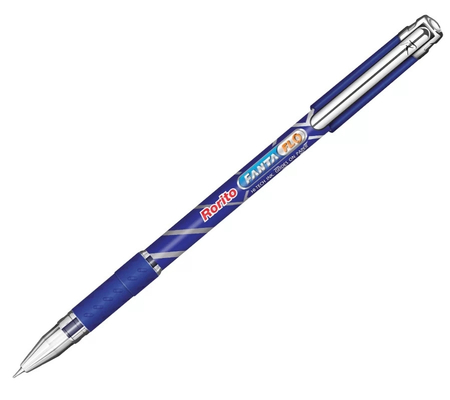
How to use it to get the best “smooth pen” feel in real life:
- Keep your grip relaxed, let the pen do the work
- Use consistent speed rather than sudden bursts that increase pressure
- Pair it with decent notebook paper if you write long sessions
Smoothness becomes most obvious when you are writing quickly, taking meeting notes, or filling pages, because that is where weak pens start dragging, and good pens keep gliding.
The Science Behind a Smooth Writing Experience
1. Tip Mechanics: The Micro-Engineering at the Point
A ballpoint pen dispenses ink over a hard ball at its point. That ball rotates as you write, acting as a moving valve between the ink reservoir and the air outside. Balls are commonly made using durable materials such as steel, brass, or tungsten carbide, then housed in a socket designed to hold the ball securely while still allowing it to roll.
Here is where “smooth pens” are won or lost:
- If the ball does not rotate freely, you feel drag and scratchiness
- If the ball-seat fit is inconsistent, ink delivery becomes uneven, causing skips or blobs
- If the ball is not perfectly seated, the pen can feel scratchy on diagonals and curves
A good tip feels smooth, not because it is loose, but because it is precise. The ball rotates smoothly with minimal resistance, and the socket meters ink evenly instead of dumping it in patches.
The start-up problem: why some pens skip at the beginning
That annoying first-stroke skip often comes from the tip not transferring ink immediately. It can happen when the ink is too thick at rest, the ball is not rotating cleanly yet, or the paper fibres momentarily interrupt the ink film. A smoother system reduces start-up resistance and maintains a consistent ink film at the point, so the pen “starts” without scribbling.
2. Ink Chemistry: Why Some Ball Pens Feel Effortless
Ink is the second half of smoothness. A ballpoint needs ink that is stable inside the refill, but responsive at the tip. Many modern ink systems use flow behaviour that changes under shear. In simple terms, the ink can be more resistant at rest, then flow more easily when the ball rolls and the writing motion applies shear. This concept is often described as shear-thinning behaviour in fluid systems.
Why this matters for “ball pen smooth” performance:
- If the ink is too resistant, you press harder to make it write, which increases the drag
- If the ink is too free-flowing, you risk smudges or blobs if the system is not well-controlled
So the best smooth pens are tuned to deliver a steady film: enough flow to glide, enough control to stay crisp.
The real-world test of good ink
A smooth pen is not only smooth for the first paragraph. It stays consistent across a full page, including:
- Long horizontal lines (where drag becomes noticeable)
- Curves (where uneven flow shows up as patchy thickness)
- Fast notes (where weak ink systems starve or skip)
A dependable ink system keeps the line uniform, so your letters do not look dark in one word and faint in the next.
3. Paper Dynamics: The Surface You Are Actually Writing On
Paper is not flat. It is a landscape of fibres. Some pages are rougher, some are coated, some absorb ink quickly, and some resist ink for longer. A pen that feels smooth on one notebook can feel scratchy on another, simply because the paper changes the friction and the way ink spreads.
This is why people buy “smooth pens” and still feel disappointed sometimes. The pen might be fine, but the paper may be:
- Too fibrous, increasing resistance and catching the ball
- Too glossy, changing traction and making strokes feel slippery
- Too absorbent, spreading ink and softening edges
A true smooth ballpoint pen is one that stays stable across everyday paper types, not only on ideal paper.
4. Ergonomics: Smooth Writing Is Also a Hand and Grip Story
A pen can have a great tip and great ink, but still feel “not smooth” if your hand is forced into tension. When a grip slips, fingers clamp down. When fingers clamp down, pressure increases. As pressure increases, drag becomes more noticeable and fatigue sets in sooner.
What supports a smoother feel during long writing:
- A secure grip that does not slip mid-line
- Comfortable barrel feel that does not force a tight pinch
- Balanced writing experience so your wrist and fingers do not overwork
This is why comfort grips matter. Smoothness is not only at the tip, but it is also in how relaxed your hand can stay while the pen does its job.
5. How to Tell if a Pen Is Truly Smooth
If you want to pick smooth pens with confidence, use quick tests that reveal real performance.
The light-pressure test: Write two lines: one with your normal pressure, one with noticeably lighter pressure. A genuinely smooth ball pen continues writing cleanly on the lighter line. If it fades or skips, the system is forcing heavy pressure.
The diagonal test: Write repeated “/” and “\” lines. Many pens behave differently on diagonals because the ball-seat interaction changes. Smooth pens stay consistent on both angles.
The pause-and-restart test: Write a sentence, pause for two seconds, then continue. Some pens starve at restart. A dependable pen resumes cleanly without scribbling.
The curve test: Draw slow figure-eights. Curves expose patchy ink delivery quickly. Smooth pens keep the line even through the entire loop.
The Rorito Way of Writing Better
Rorito is built around one simple belief: writing should feel effortless in your hand. For decades, we have created writing instruments that support smooth strokes and consistent control. From everyday pens to fine tips and fountain pens, our range is designed for real routines and real pages. We pay attention to comfort, grip balance, and ink flow, because these small details shape better writing habits. Whether you are practising handwriting or writing daily notes, the right tool makes consistency easier. Explore Rorito to find a writing style that feels natural and lasts beyond the practice page.
Summing Up
A smooth writing experience is science you can feel: a precisely working tip, ink that responds under motion, paper that supports stable contact, and ergonomics that keep your hand relaxed. Once those four align, writing stops being effort and becomes flow. If you are searching ball pen for smooth writing because your current pen drags, skips, or makes your hand tense, focus on two non-negotiables: consistent ink glide and a secure, comfortable grip. Our Rorito Fantaflo Ball Pen is designed to deliver exactly that, everyday smoothness, so your writing stays effortless from the first stroke to the last.
FAQs
1. What makes a ball pen smooth?
A smooth ball pen comes from a tip where the ball rotates freely in its socket, plus an ink system that maintains a consistent film on paper without requiring heavy pressure.
2. Are smooth pens more likely to smudge?
Not always. Smudging depends on the ink formulation, the paper’s absorbency, and how quickly the ink sets. A well-designed smooth pen balances easy flow with clean drying behaviour.
3. How can I make any pen feel smoother while writing?
Reduce pressure slightly, keep speed consistent, and use better paper. If the pen only writes well under heavy pressure, the issue is usually ink flow or tip performance, not your handwriting.
4. Is “smooth” only about ink?
No. Smoothness is the combined result of tip mechanics, ink flow behaviour under motion, paper texture, and how relaxed your grip stays.
Which Rorito pen should I choose if my priority is ball pen smooth writing?
If your goal is consistent glide and comfortable daily writing, our Rorito Fantaflo Ball Pen is designed with ink that glides on paper and a soft grip for comfort, making it a practical choice among smooth pens for everyday use.